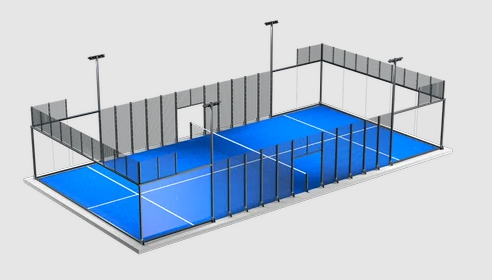
Planning to build a padel court? Choosing the right dimensions, surface system and safety features from the beginning is essential for creating a durable, high-quality sports facility.
Whether you are developing a padel court for a sports club, municipality, school, commercial facility or private sports centre, careful planning and suitable materials are key to achieving reliable playing conditions and long-term performance.
The International Padel Federation (FIP) provides the official rules of the game, which form an important reference for court dimensions, enclosure systems, playing surfaces and other technical aspects of padel court design.
B&C Skandinavia Sport offers solutions for padel courts and artificial turf, supporting projects of different sizes and requirements. Our focus is on helping customers explore practical, functional and quality-oriented solutions for sports facilities.
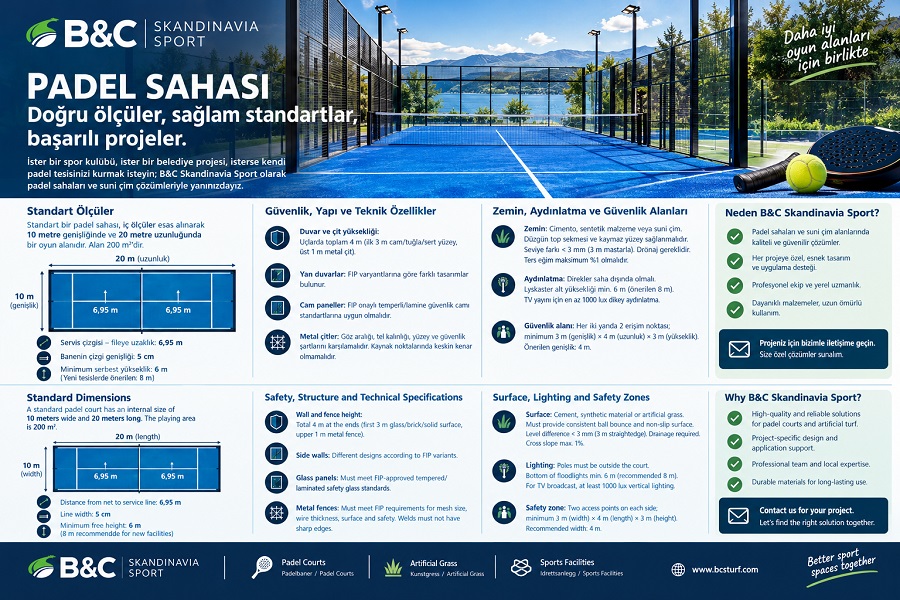
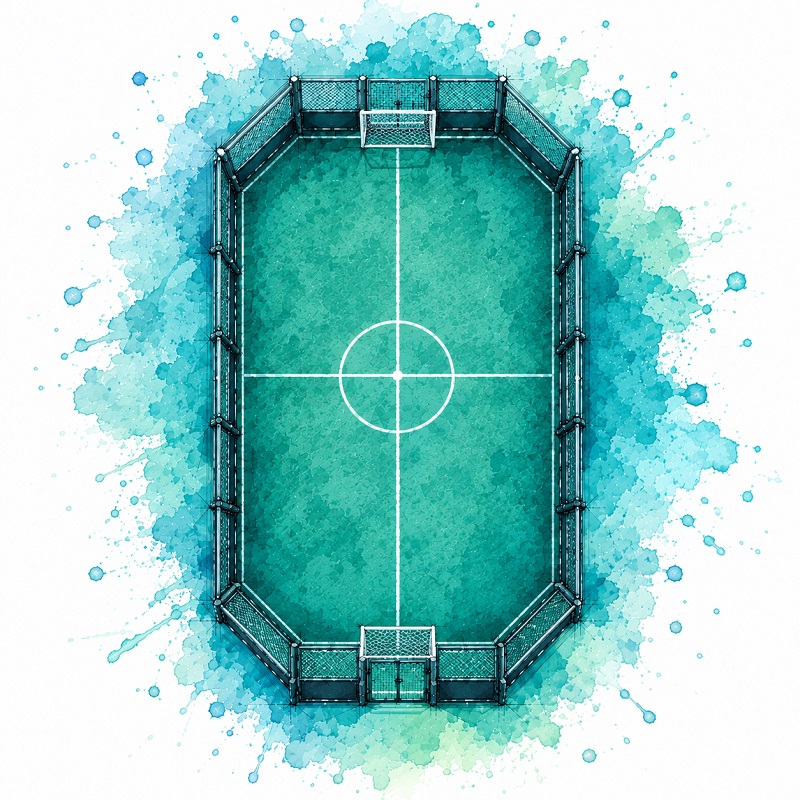
A standard padel court measures 10 metres wide and 20 metres long, measured from the inside of the enclosure. This gives a playing area of 200 m². A net divides the court into two equal halves.
The main dimensions include:
Court size: 10 × 20 metres
Distance from the net to the service lines: 6.95 metres
Line width: 5 cm
Minimum clear height: 6 metres, with 8 metres recommended for new facilities
In addition to the playing area, the surrounding structure, entrances and any required safety zones must be considered during the planning stage.
A padel court must be enclosed by a suitable combination of walls and fencing in accordance with the applicable rules. At the ends of the court, the total enclosure height is 4 metres. One possible design consists of a 3-metre lower section made from glass or another suitable solid material, with a 1-metre metal fence section above.
Several approved designs are available for the side enclosure. The exact arrangement should therefore be selected according to the relevant FIP enclosure specifications rather than relying on wall height alone.
Glass panels must meet the applicable safety-glazing requirements and any relevant approval criteria. Metal fencing must also meet the appropriate requirements for mesh openings, wire thickness, surface finish and player safety.
Compliance depends on the complete court system, not simply on the thickness of the glass or the specifications of an individual component.
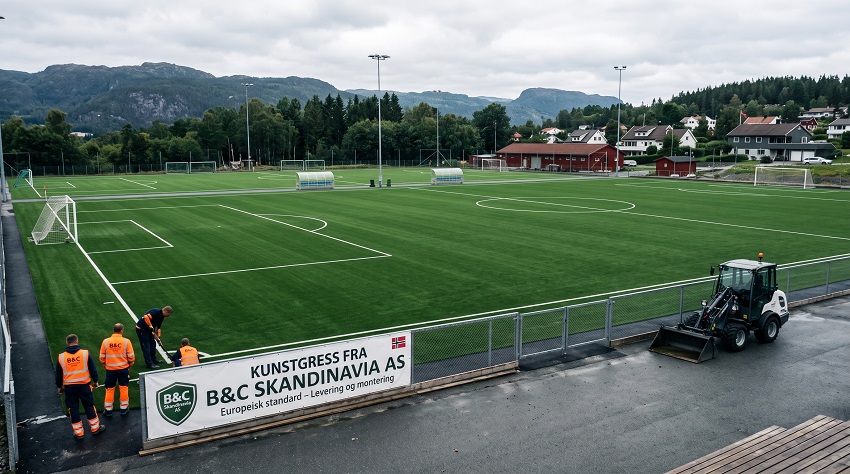
The playing surface has a direct impact on ball bounce, player movement and overall playing quality. When selecting artificial turf for a padel court, it is important to consider performance, durability and maintenance requirements as well as appearance.
Key factors include:
Ball bounce: The surface should provide consistent and predictable ball behaviour.
Traction: Players need suitable grip for controlled movement.
Durability: The turf must withstand repeated movement and frequent use.
Drainage: Outdoor courts need an effective plan for removing rainwater.
Maintenance: Product selection should take account of cleaning, upkeep and expected service life.
Under the relevant FIP court requirements, surface irregularities should be less than 3 mm when measured using a 3-metre straightedge. Where no drainage system is provided, the specified maximum cross slope is 1%.
B&C Skandinavia Sport offers artificial turf solutions for padel courts. The most suitable product should be selected according to the type of facility, expected usage and applicable technical requirements.
Good lighting helps players follow the ball clearly and provides consistent visibility across the court. The lighting design should minimise glare and avoid distracting players, officials or spectators.
FIP rules specify that lighting poles should be positioned outside the court. The minimum height for the lower part of the floodlights is specified as 6 metres, while 8 metres is recommended for new facilities.
For television broadcasts and professional video recording, a minimum vertical illuminance requirement of 1,000 lux is specified. The final lighting design should take account of light distribution, glare control and the intended use of the facility.
Facilities that allow players to return the ball from outside the court require sufficient unobstructed space around the playing area.
FIP rules describe two access points on each side and a clear area outside the court measuring at least 3 metres wide, 4 metres long and 3 metres high. A width of 4 metres is recommended.
Posts, walls and other fixed obstacles must be assessed to reduce the risk of collisions. Suitable protective padding should be installed where necessary to help protect players from impact injuries.
A successful padel project begins with proper planning. Before construction starts, the available space, ground conditions, drainage, court structure and lighting requirements should be assessed.
A typical planning process includes:
Site assessment: Determine whether the court will be indoors or outdoors and confirm the available space.
Ground preparation: Plan the foundation, levels, slope and drainage.
Court system selection: Choose suitable walls, fencing and structural components.
Artificial turf selection: Select a surface that matches the intended use and technical requirements.
Lighting and safety: Plan illumination, entrances and safety zones.
Final inspection: Check that the installation meets the relevant technical requirements and local regulations.
Careful planning can reduce costly changes during construction and help create a reliable sports facility with long-term value.
Choosing the right products and systems is an important part of any padel court investment.
B&C Skandinavia Sport works with sports facility products and artificial turf solutions, serving projects with different requirements and scales.
Our product range may be relevant for:
New padel courts for sports clubs
Municipal and community sports facilities
Schools, gyms and sports centres
Indoor and outdoor padel facilities
Artificial turf replacement and renovation projects
Every project has different requirements. The right solution depends on the available space, intended use, budget and applicable technical standards.
Explore our products and solutions on the B&C Skandinavia Sport website.
A standard padel court measures 10 × 20 metres internally, providing a playing area of 200 m². Additional space may be needed for the enclosure, access and safety zones.
FIP rules specify a minimum clear height of 6 metres above the playing area. A height of 8 metres is recommended for new facilities.
Padel-specific artificial turf should provide consistent ball bounce and suitable traction for players. Product documentation and the applicable court requirements should be checked before making a selection.
Yes. However, foundations, drainage, construction materials and structural design must be suitable for local weather conditions and ground characteristics.
Consider the dimensions, playing surface, glass panels, fencing, drainage, lighting, safety provisions, installation requirements and any applicable approval criteria.
Whether you are building a new padel court or upgrading an existing sports facility, selecting the right court system and artificial turf is essential for long-term performance.
B&C Skandinavia Sport can help you explore padel court and artificial turf solutions suited to your project's needs.
Visit bcsturf.com to explore our products and learn more about our solutions.